






A pharmaceutical cleanroom is more than a controlled space. It is an integrated manufacturing environment designed to protect product quality, control contamination, support repeatable operations, and meet applicable regulatory expectations.
Effective pharmaceutical cleanroom design requires coordination across facility layout, HVAC, personnel and material flow, cleanroom classification, construction materials, environmental monitoring, qualification, and lifecycle maintenance.
This becomes especially important in a sterile manufacturing facility, where exposed sterile products, components, and product-contact surfaces depend heavily on the surrounding environment for protection against microbial and particulate contamination.
For teams planning a new pharmaceutical manufacturing space or expanding an existing site, AES Clean Technology provides BioPharma cleanroom solutions designed around the regulatory, operational, and scalability requirements of modern drug manufacturing.
Key Takeaways
- Pharmaceutical cleanroom design should begin with the manufacturing process and contamination risks, not with ISO classification alone.
- ISO 14644 classification is important, but ISO classification by itself does not establish CGMP compliance.
- HVAC, pressure relationships, zoning, personnel flow, material flow, cleanability, and environmental monitoring should function as one integrated system.
- In aseptic processing, critical zones commonly require ISO 5 conditions, while surrounding areas are classified according to process risk.
- A sterile manufacturing facility should be designed for qualification, cleaning, monitoring, maintenance, and future change — not just initial startup.
On This Page
- What Is a Pharmaceutical Cleanroom?
- Pharmaceutical Cleanroom Standards and Regulations
- HVAC, Airflow, and Pressure Control
- Cleanroom Materials and Cleanability
- Sterile Manufacturing Facility Design
- Environmental Monitoring and Qualification
- Pharmaceutical Cleanroom Design Checklist
- Download the Pharmaceutical Cleanroom Design Checklist
- Common Pharmaceutical Cleanroom Design Mistakes
- FAQ: Pharmaceutical Cleanroom Design
- Sources
What Is a Pharmaceutical Cleanroom?
A pharmaceutical cleanroom is a controlled manufacturing environment where airborne particles and, where required, microbiological contamination are maintained at levels appropriate for the process.
Cleanroom design can directly affect:
- Product protection
- Cross-contamination risk
- Personnel practices
- Material movement
- Cleaning and disinfection
- HVAC performance
- Environmental monitoring
- Qualification and validation
- Maintenance
There is no single cleanroom design that applies to every pharmaceutical process. An aseptic filling suite, biologics manufacturing area, oral solid dose environment, cell and gene therapy suite, and equipment wash area may all require different levels of control.
The cleanroom should therefore be designed around the process it protects.
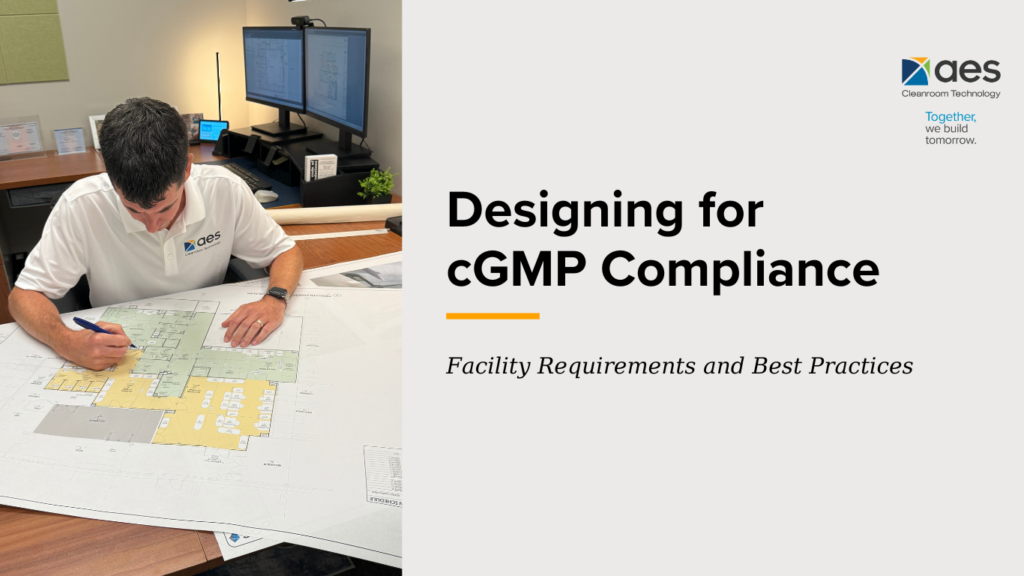
For broader facility planning considerations, see AES’s guide to designing for cGMP compliance.
Pharmaceutical Cleanroom Standards and Regulations
Pharmaceutical cleanroom design is influenced by multiple regulations, standards, and guidance documents.
These standards work together but should not be treated as interchangeable.
21 CFR Part 211
FDA requirements under 21 CFR Part 211 address pharmaceutical buildings, facilities, ventilation, filtration, environmental controls, cleaning, and manufacturing operations.
For aseptic processing, facility design should support appropriate:
- Cleanable surfaces
- Temperature and humidity control
- HEPA filtration
- Pressure relationships
- Environmental monitoring
- Cleaning and disinfection
- Maintenance
ISO 14644
ISO 14644-1 establishes airborne particle classification requirements, while ISO 14644-2 addresses monitoring strategies used to demonstrate continued performance.
However, ISO classification alone does not make a pharmaceutical cleanroom CGMP compliant. Facility design must also address contamination control, microbiological risks, process requirements, documentation, and other regulatory expectations.
For more detail, see AES’s resource on cleanroom ISO classification.
EU GMP Annex 1
For sterile medicinal products, EU GMP Annex 1 places significant emphasis on a facility-wide Contamination Control Strategy (CCS).
The CCS connects facility design with:
- Cleanroom classification
- Airflow
- Barrier technologies
- Personnel practices
- Material transfer
- Cleaning and disinfection
- Environmental monitoring
- Utilities
- Quality risk management
The key principle is that contamination control should be integrated into the entire facility rather than managed through isolated procedures.
Pharmaceutical Cleanroom Design Best Practices
1. Start With the Manufacturing Process
Before selecting room classifications or finalizing layouts, define:
- Product type
- Process steps
- Product exposure
- Equipment
- Personnel requirements
- Materials and waste
- Utilities
- Cleaning requirements
- Future capacity
A process-first approach helps prevent unnecessary over-classification and ensures the facility supports actual manufacturing needs.
2. Design Around Contamination Risk
Potential contamination sources include:
- Personnel
- Air
- Materials
- Equipment
- Utilities
- Cleaning activities
- Maintenance
- Adjacent operations
- Waste
In sterile manufacturing, special attention should be paid to every location where sterile product or sterile product-contact surfaces are exposed.
For additional context, AES’s guide to cGMP vs GMP in cleanrooms explains why current contamination control practices are central to modern CGMP environments.
3. Establish Personnel and Material Flows Early
Poor flow design can create unnecessary contamination risk and operating inefficiencies.
A pharmaceutical cleanroom should clearly define:
Personnel flow:
Entry → gowning → controlled transition → processing → degowning → exit
Material flow:
Receiving → staging → cleaning/decontamination → controlled transfer → manufacturing → removal
Waste, dirty equipment, and maintenance activities should also be considered independently so they do not interfere with clean operations.
AES Compass™ conceptual facility planning helps teams establish cleanroom classifications, GMP zoning strategies, airflow needs, and operational flows early in project development.
HVAC, Airflow, and Pressure Control
HVAC is one of the most important systems in pharmaceutical cleanroom design because it affects:
- Particle control
- Microbial contamination risk
- Pressure relationships
- Temperature
- Humidity
- Airflow direction
- Recovery
- Process stability
A cleanroom HVAC strategy should be designed around the process rather than treated as a generic building system.
Pressure Cascades
For product protection, air generally moves from cleaner spaces toward adjacent areas of lower cleanliness.
FDA aseptic processing guidance cites approximately 10–15 Pa as an example of an appropriate positive pressure differential between adjacent rooms of different classifications when doors are closed.
However, containment processes may require different pressure strategies, including negative pressure.
The design must therefore balance product protection, operator protection, and containment requirements.
Airflow Matters More Than Air Change Rate Alone
Air changes per hour are important, but they should not be considered in isolation.
Design teams should also evaluate:
- Supply and return locations
- Equipment placement
- Heat loads
- Room geometry
- Door operation
- Personnel positions
- Airflow obstructions
- Recovery requirements
AES’s cleanroom engineering services integrate mechanical, electrical, process, and architectural considerations for regulated cleanroom environments.
Cleanroom Materials and Cleanability
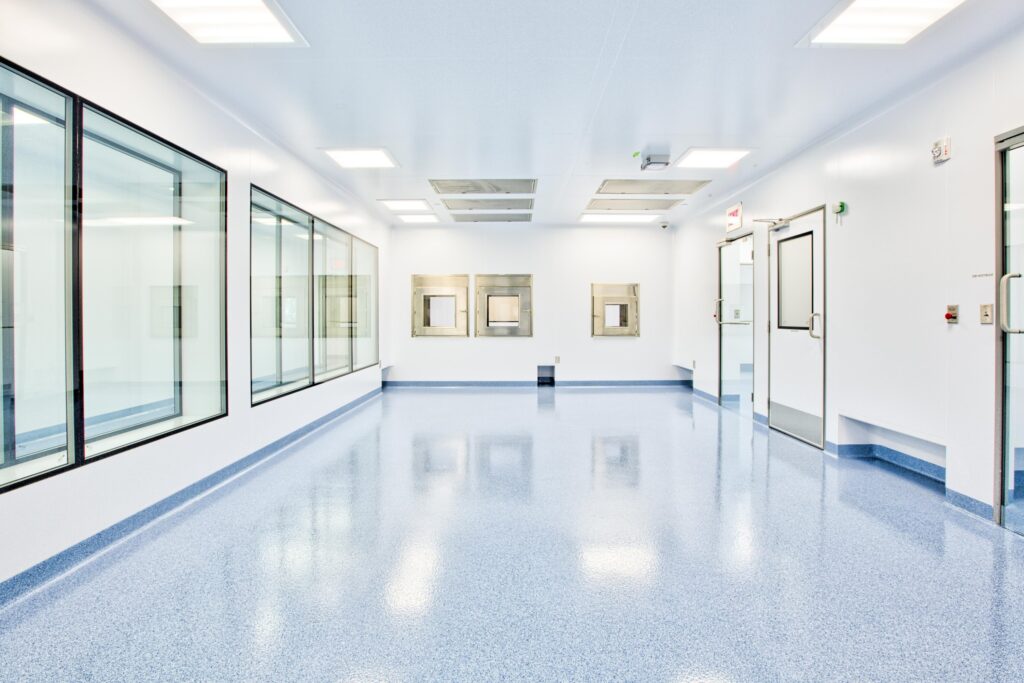
A pharmaceutical cleanroom should be repeatedly cleanable and disinfectable without degrading the facility envelope.
Design details should minimize:
- Cracks and gaps
- Exposed fasteners
- Particle traps
- Horizontal ledges
- Difficult-to-access corners
- Unsealed penetrations
Important cleanroom components include:
- Walls
- Ceilings
- Floors
- Doors
- Windows
- Coving
- Utility penetrations
- Lighting
- Access panels
Materials should also be compatible with the cleaning agents and disinfectants used in the facility.
AES’s modular cleanroom walls and ceilings are designed around cleanability, durability, sealed transitions, and long-term facility flexibility.
Sterile Manufacturing Facility Design
A sterile manufacturing facility requires additional contamination controls because finished-product testing alone cannot assure sterility.
When sterile product is exposed, facility design may need to account for:
- ISO 5 critical zones
- Unidirectional airflow
- Controlled cleanroom backgrounds
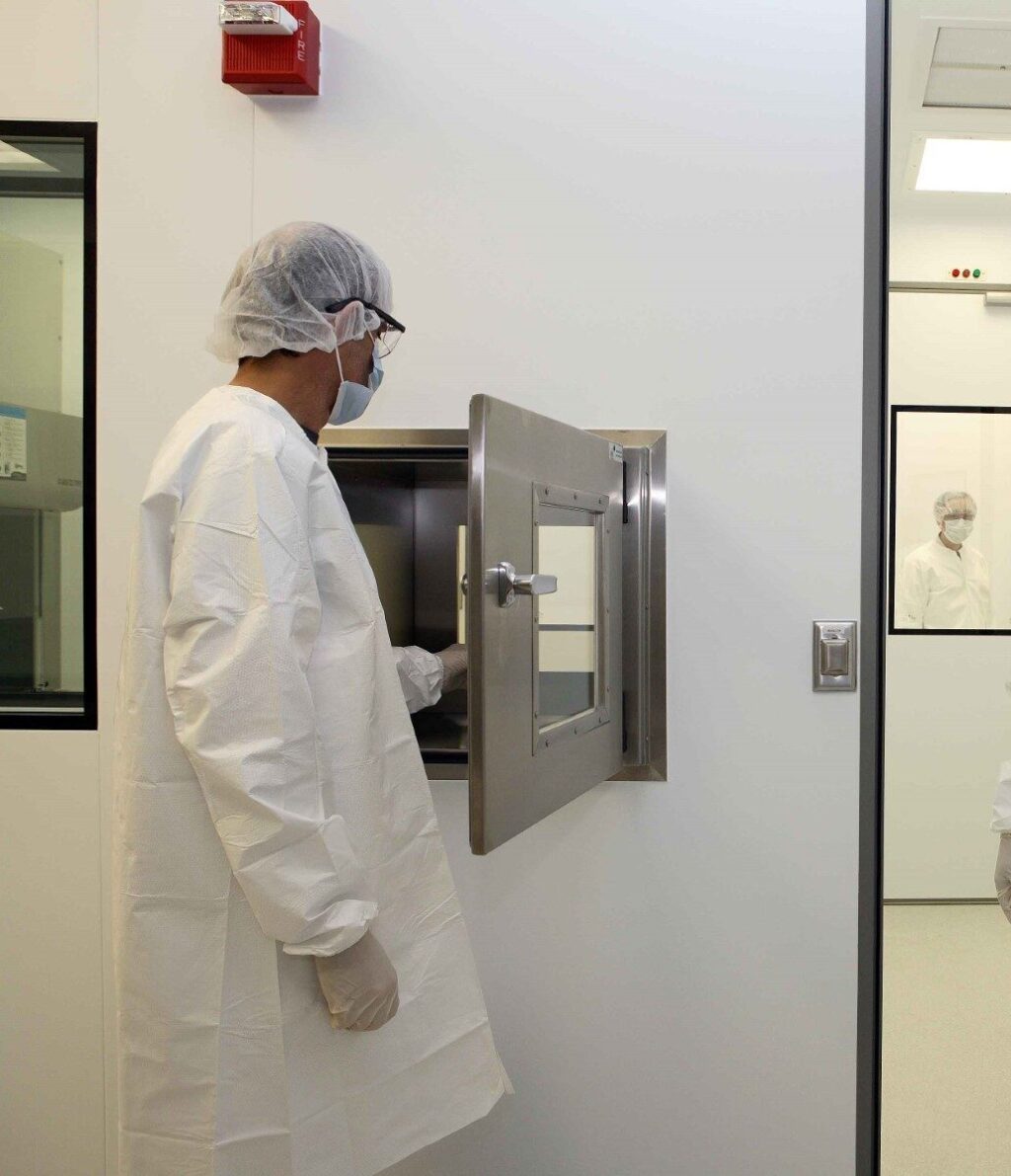
- Personnel and material airlocks
- Interlocked doors
- Controlled transfers
- Environmental monitoring
- Intervention reduction
- Barrier technology
RABS and Isolators
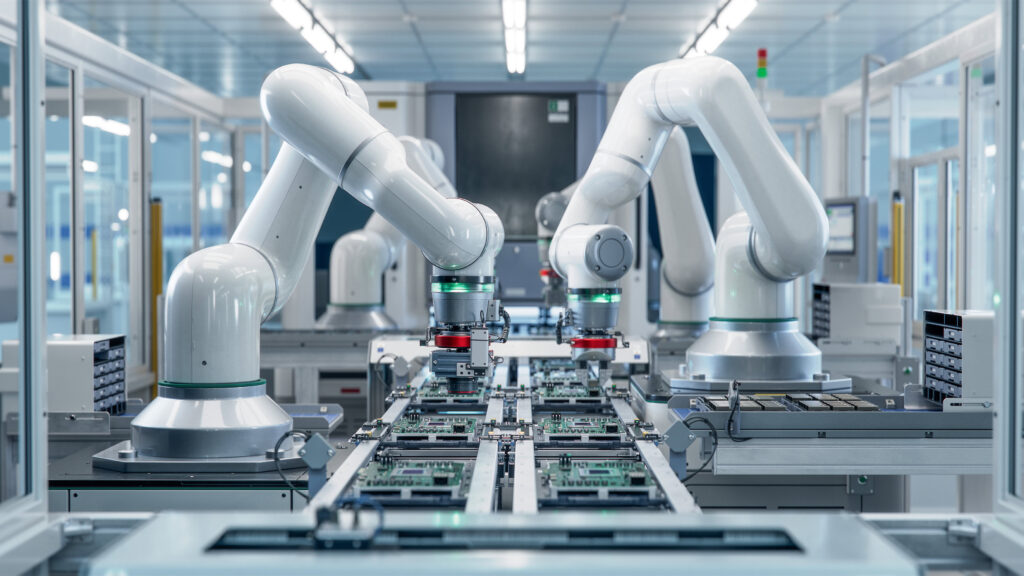
Modern sterile facilities increasingly use technologies such as:
- Restricted Access Barrier Systems (RABS)
- Isolators
- Robotics
- Closed processing
- Rapid transfer ports
These systems can help reduce operator interaction with critical processes and lower contamination risk.
They should be incorporated into the facility concept early so HVAC, maintenance access, transfers, decontamination strategy, and equipment interfaces are properly coordinated.
Environmental Monitoring and Qualification
A pharmaceutical cleanroom must demonstrate that it performs as intended and remains in control over time.
Environmental monitoring may include:
- Nonviable particles
- Viable air monitoring
- Surface monitoring
- Personnel monitoring
- Differential pressure
- Temperature
- Humidity
- Alarm conditions
- Trending
Monitoring locations should reflect process risk rather than being selected only for convenience.
Qualification and lifecycle activities may include:
- Design qualification
- Factory Acceptance Testing
- Site Acceptance Testing
- Commissioning
- IQ/OQ/PQ
- Cleanroom classification
- HEPA filter integrity testing
- Airflow visualization
- Pressure verification
- Temperature and humidity testing
- Recovery testing
Designing for these activities early can improve project turnover and reduce qualification delays.
Pharmaceutical Cleanroom Design Checklist
Before finalizing a pharmaceutical cleanroom design, confirm that the project addresses:
- Process requirements— What product and manufacturing process will the cleanroom support?
- Contamination risks— Where can contaminants affect product quality?
- Classification and zoning— Which spaces require specific classifications or GMP grades?
- Personnel and material flows— Can people, materials, product, waste, and equipment move without unnecessary conflicts?
- HVAC strategy— Are airflow, filtration, pressure, temperature, and humidity aligned with process requirements?
- Cleanability— Are surfaces and transitions designed for routine cleaning and disinfection?
- Equipment and utilities— Are they integrated without compromising airflow, cleaning, or maintenance?
- Monitoring and qualification— Can the facility be effectively monitored, tested, and documented?
- Maintenance— Can filters, sensors, utilities, and equipment be serviced without disrupting controlled areas?
- Future flexibility — Can the facility support expansion, reconfiguration, or process changes?
Download the Pharmaceutical Cleanroom Design Checklist
Use this 10-point pharmaceutical cleanroom design checklist to evaluate process requirements, contamination risks, cleanroom classification, personnel and material flows, HVAC strategy, cleanable materials, equipment integration, monitoring, maintainability, and future facility flexibility.
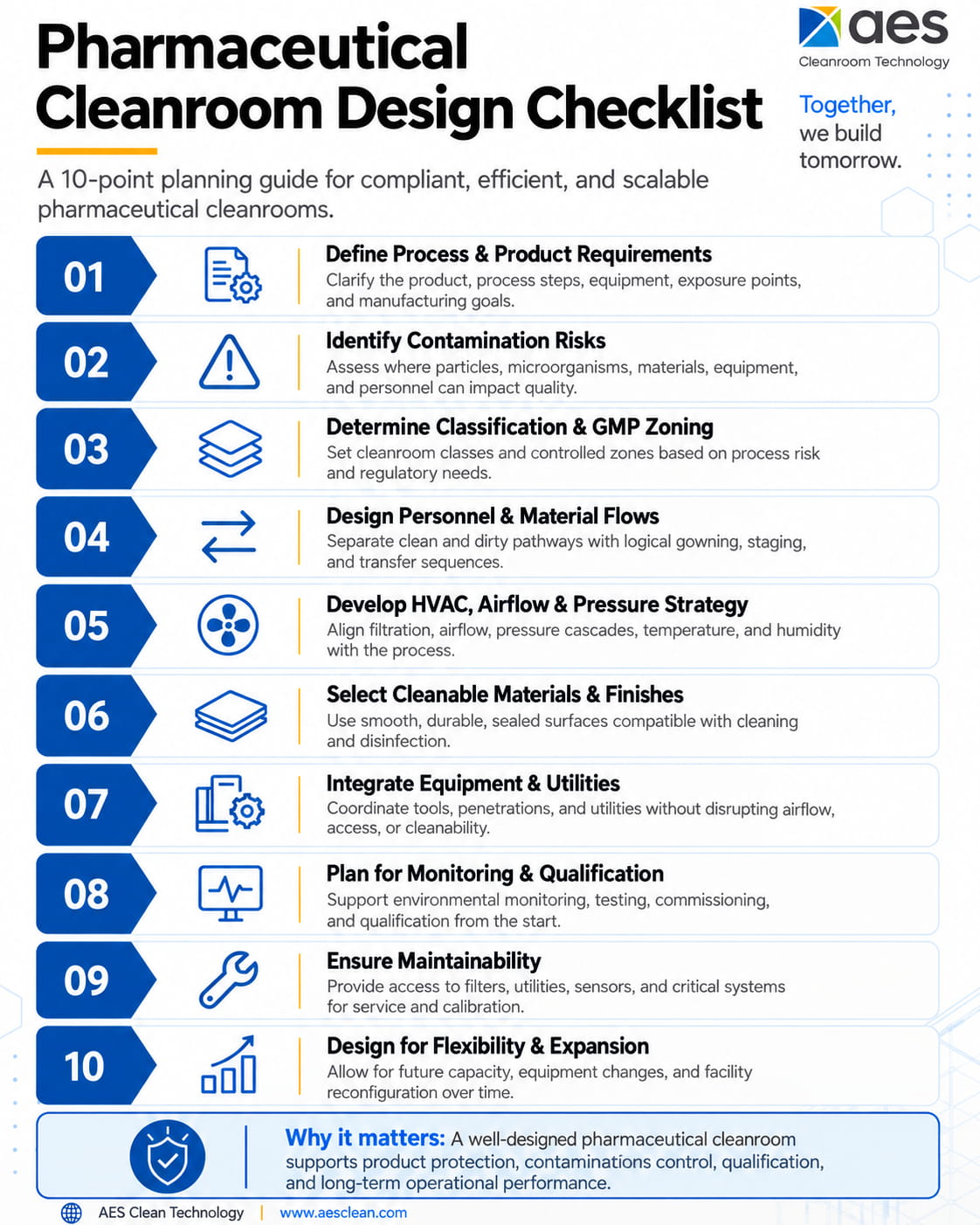
Fig. 1: Pharmaceutical cleanroom design checklist outlining 10 key planning considerations for compliant, efficient, and scalable pharmaceutical and sterile manufacturing facilities.
Common Pharmaceutical Cleanroom Design Mistakes
Common design mistakes include:
- Selecting ISO classifications before understanding process risk
- Assuming ISO classification alone establishes CGMP compliance
- Underestimating gowning and material staging needs
- Allowing personnel and material routes to conflict
- Designing HVAC independently from process equipment
- Ignoring airflow disruption caused by equipment
- Selecting materials that are difficult to clean
- Adding environmental monitoring too late
- Failing to plan maintenance access
- Treating qualification documentation as an end-of-project activity
- Designing only for current capacity
Early coordination across engineering, quality, validation, operations, and manufacturing teams can prevent many of these issues.
AES’s architectural cleanroom design and pre-construction services help connect design, constructability, process requirements, and regulatory considerations before construction begins.
The Bottom Line: Pharmaceutical Cleanroom Design Is an Integrated System
Successful pharmaceutical cleanroom design is not defined by a single ISO classification, pressure differential, wall system, or airflow rate.
It is the result of an integrated approach where:
- The process defines the facility
- Risk determines the required level of control
- HVAC supports contamination control
- Personnel and material flows reduce contamination pathways
- Cleanroom materials support cleaning and disinfection
- Monitoring demonstrates continued control
- Qualification verifies performance
- Maintenance protects the validated state
- Flexibility supports future manufacturing needs
For a sterile manufacturing facility, these relationships become even more important because cleanroom design directly contributes to contamination control and product protection.
To discuss pharmaceutical cleanroom planning, engineering, modular construction, or facility expansion, contact AES Clean Technology.
FAQ: Pharmaceutical Cleanroom Design
What is a pharmaceutical cleanroom?
A pharmaceutical cleanroom is a controlled manufacturing environment designed to manage airborne particles and, where required, microbiological contamination to levels appropriate for pharmaceutical production.
What standards apply to pharmaceutical cleanroom design?
Common requirements and guidance include FDA 21 CFR Parts 210 and 211, FDA aseptic processing guidance, ISO 14644 standards, EU GMP Annex 1, and ICH Q9(R1). Applicable requirements depend on the product, process, facility, and regulatory market.
What ISO classification is required for a pharmaceutical cleanroom?
There is no single ISO classification for all pharmaceutical cleanrooms. Classification should be based on process risk. For conventional aseptic processing, FDA guidance identifies ISO 5 for critical areas where sterile product is exposed.
Is ISO 14644 compliance enough for a pharmaceutical cleanroom?
No. ISO 14644 addresses cleanroom classification and monitoring, but pharmaceutical facilities must also address CGMP requirements, microbiological controls, contamination risks, documentation, and process-specific regulatory expectations.
Why is HVAC important in pharmaceutical cleanroom design?
HVAC helps control particles, microorganisms, pressure, airflow direction, temperature, humidity, and recovery. These conditions directly influence cleanroom performance and contamination control.
What is a sterile manufacturing facility?
A sterile manufacturing facility is a controlled manufacturing environment designed to produce sterile products. It may include multiple cleanrooms, airlocks, barrier systems, utilities, sterilization equipment, and controlled support areas.
What materials are best for pharmaceutical cleanrooms?
Materials should generally be smooth, durable, non-shedding, sealed, easily cleanable, and compatible with routine cleaning agents and disinfectants.
Are modular cleanrooms suitable for pharmaceutical manufacturing?
Yes. Properly designed modular cleanroom systems can support pharmaceutical and biopharmaceutical manufacturing while providing cleanable finishes, controlled fabrication, integrated HVAC, scalability, and future flexibility.
Sources
- FDA — Sterile Drug Products Produced by Aseptic Processing: Current Good Manufacturing Practice
- FDA — Current Good Manufacturing Practice Regulations
- eCFR — 21 CFR § 211.42: Design and Construction Features
- eCFR — 21 CFR § 211.46: Ventilation, Air Filtration, Air Heating and Cooling
- ISO — ISO 14644-1:2015 Cleanrooms and Associated Controlled Environments
- ISO — ISO 14644-2:2015 Cleanroom Monitoring
- European Commission — EU GMP Annex 1: Manufacture of Sterile Medicinal Products
- ICH — Q9(R1) Quality Risk Management