




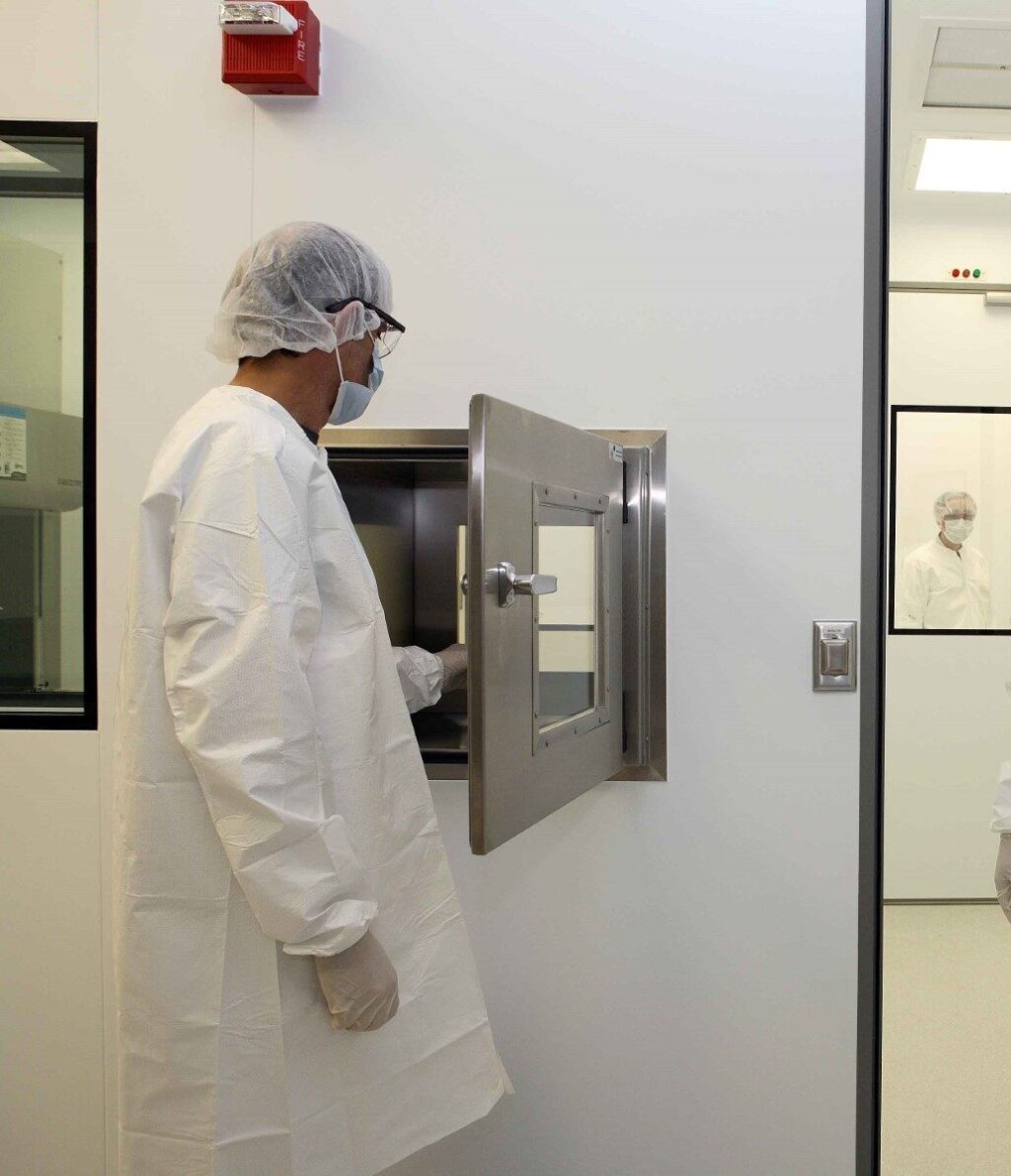

An ISO 5 cleanroom is a highly controlled environment designed to maintain extremely low concentrations of airborne particles under ISO 14644-1. Commonly associated with aseptic pharmaceutical manufacturing, sterile processing, biotechnology, and contamination-sensitive production, ISO Class 5 environments provide stringent airborne particle control for critical operations.
However, achieving ISO 5 requirements involves much more than installing HEPA filters or passing an initial particle classification test. Effective contamination control depends on airflow patterns, equipment placement, personnel practices, gowning, facility design, environmental monitoring, cleaning, and ongoing qualification.
An important distinction is that ISO 5 cleanliness may be achieved within a localized critical zone, such as a unidirectional airflow workstation, restricted access barrier system (RABS), or isolator, rather than throughout an entire manufacturing room.
For organizations developing contamination-sensitive manufacturing facilities, understanding how to design and maintain ISO Class 5 conditions can help improve product protection, process reliability, and long-term operational performance.
AES Clean Technology supports regulated manufacturing environments through integrated cleanroom engineering services that coordinate airflow, filtration, mechanical systems, utilities, and facility requirements.
Key Takeaways
- ISO Class 5 permits a maximum of 3,520 airborne particles per cubic meter at sizes ≥0.5 µm under ISO 14644-1.
- ISO 5 is commonly associated with critical aseptic processing areas where sterile products or components are exposed.
- Unidirectional airflow and HEPA filtration are important technologies for protecting critical manufacturing zones.
- ISO 5 gowning requirements depend on process risk, facility configuration, and applicable regulations; ISO classification alone does not prescribe one universal gowning ensemble.
- ISO 5 conditions can be provided through localized clean zones, RABS, or isolators rather than requiring an entire room to meet ISO 5.
- Cleanroom classification alone does not establish cGMP compliance, sterility assurance, or microbiological control.
On This Page
- What Is an ISO 5 Cleanroom?
- ISO 5 Cleanroom Particle Limits
- ISO 5 vs ISO 7: Understanding the Differences
- Where Are ISO 5 Cleanrooms Used?
- ISO 5 Cleanroom Design Requirements
- ISO 5 Gowning Requirements
- ISO 5 Environmental Monitoring and Qualification
- ISO 5 Cleanroom Requirements Checklist
- Download the ISO 5 Cleanroom Requirements Checklist
- Common ISO 5 Cleanroom Mistakes
- FAQ: ISO 5 Cleanroom Requirements
- Sources
What Is an ISO 5 Cleanroom?
An ISO 5 cleanroom, also referred to as ISO Class 5, is a cleanroom or clean zone classified according to the maximum allowable concentration of airborne particles under ISO 14644-1.
ISO Class 5 is commonly associated with the former U.S. Federal Standard 209E Class 100 cleanroom designation.
Because ISO 5 establishes stringent particle limits, it is frequently used to protect critical manufacturing processes where contamination could compromise product quality.
Potential applications include:
- Aseptic pharmaceutical filling
- Sterile component handling
- Certain biotechnology manufacturing operations
- Cell and gene therapy processing
- Critical sterile product exposure points
- Highly contamination-sensitive manufacturing
The appropriate use of ISO Class 5 depends on the product, manufacturing process, exposure risks, and applicable regulatory expectations.
ISO 5 does not automatically mean the entire facility must maintain ISO 5 cleanliness. In many regulated environments, critical processes are protected within localized ISO 5 zones surrounded by supporting cleanrooms with different cleanliness classifications.
For broader facility planning considerations, explore AES’s pharmaceutical cleanroom design guide, which discusses contamination control, cleanroom zoning, HVAC, and sterile manufacturing facility requirements.
ISO 5 Cleanroom Particle Limits
Under ISO 14644-1:2015, ISO Class 5 establishes maximum allowable concentrations for airborne particles at specified sizes.
ISO Class 5 Particle Concentration Limits
| Particle Size | Maximum Particles per m³ |
|---|---|
| ≥0.1 µm | 100,000 |
| ≥0.2 µm | 23,700 |
| ≥0.3 µm | 10,200 |
| ≥0.5 µm | 3,520 |
| ≥1.0 µm | 832 |
These concentration limits are cumulative, meaning each value includes particles equal to or larger than the specified size.
ISO 14644-1:2015 does not assign a standard ISO Class 5 classification limit at ≥5.0 µm in its primary classification table because low particle concentrations and sampling limitations make classification at that size inappropriate. A separate macroparticle descriptor may be used where applicable.
Cleanroom classification should also identify the relevant occupancy state:
- As-built: The cleanroom is complete, without production equipment or personnel.
- At-rest: Equipment is installed and operating as specified, without personnel performing production activities.
- Operational: The facility is operating under defined conditions with personnel and equipment present.
The required occupancy state should be established according to the manufacturing process and applicable quality requirements.
Important: ISO 14644-1 establishes airborne particle concentration limits. It does not independently establish microbial contamination limits, aseptic-processing requirements, gowning ensembles, or universal airflow velocities.
ISO 5 vs ISO 7: Understanding the Differences
ISO 5 and ISO 7 are both classifications under ISO 14644-1, but ISO 5 permits substantially lower airborne particle concentrations.
ISO Class 5 vs ISO Class 7 Particle Limits
| Classification | ≥0.5 µm particles/m³ | ≥1.0 µm particles/m³ |
|---|---|---|
| ISO 5 | 3,520 | 832 |
| ISO 7 | 352,000 | 83,200 |
At these particle sizes, ISO 5 permits 100 times fewer airborne particles than ISO 7.
However, a more stringent classification is not necessarily appropriate throughout an entire manufacturing facility.
ISO 5 may be necessary to protect exposed sterile products or other highly contamination-sensitive processes, while ISO 7 may support surrounding manufacturing and preparation activities where justified.
This distinction can significantly influence cleanroom design, HVAC capacity, operating costs, and contamination control strategy.
For a more detailed review of surrounding classified spaces, see AES’s ISO 7 cleanroom requirements guide.
Where Are ISO 5 Cleanrooms Used?
ISO Class 5 environments are most valuable when critical manufacturing activities require stringent control of airborne particles.
Aseptic Pharmaceutical Manufacturing
For aseptic processing, FDA guidance identifies ISO 5 conditions for critical areas where sterilized products, containers, closures, or product-contact surfaces are exposed.
Examples include:
- Aseptic filling points
- Stopper bowls and component handling
- Open sterile containers
- Critical aseptic connections
- Exposed sterile product-contact surfaces
These areas require environmental conditions that support contamination prevention throughout manufacturing operations.
AES’s guide to FDA cleanroom requirements explains the broader facility, HVAC, environmental monitoring, and contamination-control expectations associated with regulated manufacturing.
Barrier Systems and Localized Clean Zones
ISO 5 conditions may be achieved within:
- Unidirectional airflow workstations
- Restricted Access Barrier Systems (RABS)
- Isolators
- Localized clean air modules
- Other appropriately engineered clean zones
These technologies can help protect critical operations while allowing surrounding facility spaces to operate under different classifications.
For manufacturers evaluating localized airflow solutions, AES offers integrated cleanroom components, including the AES Pharmaflow™ self-contained laminar downflow module and HEPA fan/filter equipment.
ISO 5 Cleanroom Design Requirements
Designing an ISO 5 cleanroom or critical clean zone requires close coordination between process requirements, airflow engineering, filtration, equipment integration, and contamination control.
1. Unidirectional Airflow and HEPA Filtration
Unidirectional airflow is a common approach to protecting critical ISO 5 environments during aseptic manufacturing.
The objective is to provide clean, filtered air that moves across critical product exposure areas and carries particles away from sterile materials.
Important considerations include:
- HEPA filtration
- Appropriate airflow velocity
- Airflow uniformity
- Supply and return arrangements
- Equipment-related obstructions
- Personnel positioning
- Process heat loads
- Airflow visualization
- Filter integrity testing
Although FDA aseptic-processing guidance discusses airflow velocity recommendations for certain critical areas, ISO 14644-1 does not prescribe one universal airflow velocity or air change rate for every ISO 5 cleanroom.
Airflow requirements should be established according to the application and demonstrated through appropriate testing.
AES’s cleanroom engineering capabilities help coordinate filtration, airflow patterns, mechanical integration, and environmental control strategies for critical manufacturing environments.
2. Pressure Control and Facility Layout
ISO 5 cleanroom design should support appropriate airflow relationships between the critical zone and surrounding environments.
Important considerations include:
- Pressure cascades
- Personnel entry and exit
- Material transfer
- Equipment placement
- Controlled access
- Maintenance accessibility
- Containment requirements
- Cleanroom zoning
Positive pressure is commonly used for product protection, while certain hazardous or potent compound processes may require containment strategies involving negative pressure or specialized barrier systems.
The correct approach depends on the process and associated risks.
3. Cleanable Materials and Equipment Integration
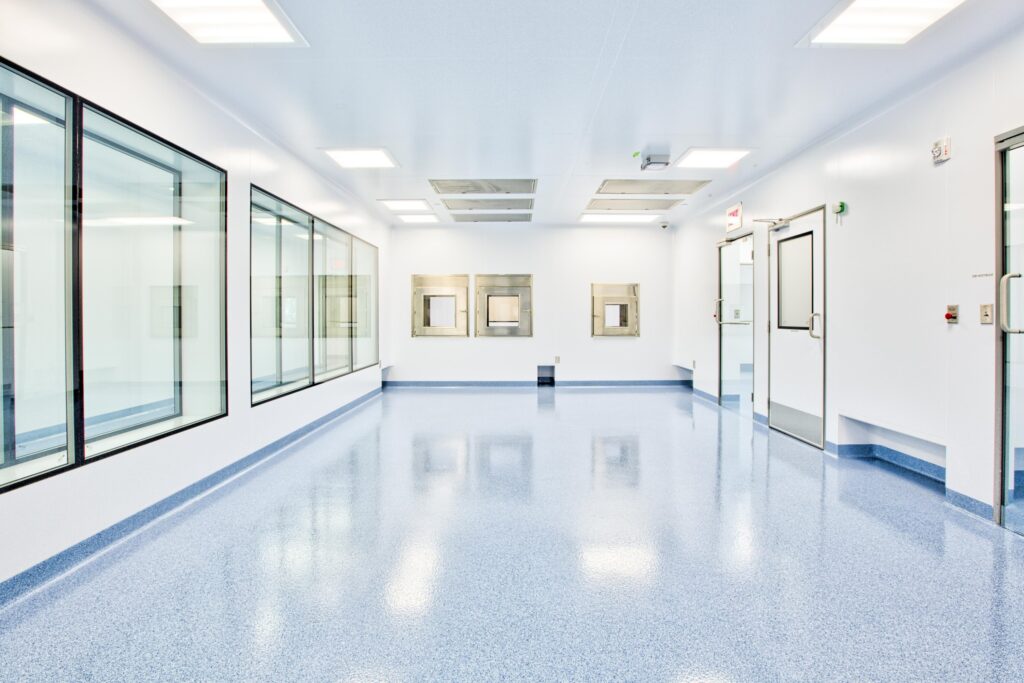
Highly controlled manufacturing environments should be designed to minimize particle generation and support effective cleaning and disinfection.
Important construction considerations include:
- Smooth, durable finishes
- Sealed joints and penetrations
- Minimal particle-trapping surfaces
- Cleanable transitions
- Compatible materials
- Accessible equipment interfaces
- Appropriate lighting
- Maintenance access
Cleanroom doors and windows can also influence pressure integrity, cleaning access, and personnel movement.
AES’s modular cleanroom windows and doors are engineered for controlled environments, with cleanable finishes, sealed construction, and access-control compatibility.
For facility expansion or retrofits, early coordination between the cleanroom envelope and process equipment can help reduce installation conflicts and downstream qualification issues.
ISO 5 Gowning Requirements
Personnel are a potential source of airborne particles and microbial contamination, making ISO 5 gowning and aseptic behavior important operational considerations.
However, ISO 14644-1 does not establish one universal gowning ensemble for every ISO Class 5 environment.
The appropriate garments and procedures depend on whether personnel work directly in the critical area, the product and process risks, the surrounding facility classification, and applicable industry regulations.
For aseptic pharmaceutical manufacturing, requirements may be significantly more stringent than those for non-pharmaceutical clean manufacturing.
Typical ISO 5 Gowning Considerations
Depending on the process, a gowning program may include:
- Cleanroom hoods
- Face masks
- Sterile or appropriately controlled gloves
- Low-shedding garments or coveralls
- Cleanroom footwear or sterile boots
- Covered facial hair
- Hand hygiene and glove disinfection
- Defined garment handling procedures
- Gowning qualification and personnel training
For sterile pharmaceutical manufacturing under EU GMP Annex 1, the gowning requirements for operators entering Grade B areas supporting Grade A operations are more specific, including sterile protective garments and associated personnel qualification requirements.
Importantly, an ISO 5 critical zone within an isolator or barrier system may have different personnel gowning needs than an open aseptic processing environment.
Recommended Gowning Best Practices
A strong gowning program should establish:
- A defined gowning sequence
- Appropriate garment selection
- Personnel training and qualification
- Proper glove handling and disinfection
- Controlled personnel movement
- Procedures for garment replacement
- Appropriate entry and exit practices
ISO 14644-5:2025 addresses cleanroom operational control programs, including personnel management, gowning, cleaning, maintenance, and training.
The purpose of gowning is not simply to meet a dress requirement. It is to reduce contamination introduced by personnel and protect critical manufacturing operations.
ISO 5 Environmental Monitoring and Qualification
Maintaining ISO 5 conditions requires ongoing verification that the environment continues to perform as intended.
For critical pharmaceutical applications, environmental monitoring may include:
- Nonviable airborne particle monitoring
- Viable air monitoring
- Surface monitoring
- Personnel monitoring
- Airflow verification
- Pressure monitoring
- Temperature and humidity
- HEPA filter integrity testing
- Alarm monitoring
- Trend analysis
The scope and frequency of monitoring should be established according to manufacturing risks and applicable regulatory requirements.
ISO 14644-2:2015 provides requirements for monitoring plans related to airborne particle cleanliness, while ISO 14644-3:2019 addresses cleanroom performance test methods.
Qualification activities may include installation qualification, operational qualification, performance qualification, classification testing, and airflow visualization studies, depending on the facility and quality system.
Testing should demonstrate that critical manufacturing areas are protected under the intended operating conditions.
ISO 5 Cleanroom Requirements Checklist
Before designing, qualifying, or operating an ISO Class 5 cleanroom or critical clean zone, evaluate these 10 considerations:
- Classification and Occupancy State: Define the applicable ISO Class 5 particle limits and the required classification state.
- Process and Contamination Risks: Identify product exposure, interventions, equipment, and contamination hazards.
- Unidirectional Airflow: Establish appropriate airflow patterns to protect critical operations.
- HEPA Filtration: Design and verify filtration systems that support ISO 5 particle control.
- Pressure Relationships: Establish pressure cascades appropriate to product protection or containment.
- Facility Layout and Access: Minimize contamination risks through controlled personnel, materials, and equipment movement.
- ISO 5 Gowning: Define appropriate garments, personnel practices, and aseptic technique requirements.
- Environmental Monitoring: Establish particle monitoring, pressure verification, temperature, humidity, and alarm strategies.
- Cleaning and Maintenance: Implement documented cleaning, equipment maintenance, and contamination-control procedures.
- Testing and Qualification: Verify cleanroom performance through appropriate classification testing, documentation, and periodic reassessment.
Download the ISO 5 Cleanroom Requirements Checklist
Use this 10-point ISO 5 cleanroom checklist as a practical reference for evaluating cleanroom classification, unidirectional airflow, HEPA filtration, pressure control, gowning, contamination control, environmental monitoring, cleaning, and qualification requirements.
Designed for facility planners, engineers, manufacturing teams, and quality professionals, this downloadable resource highlights the critical design and operational considerations for achieving and maintaining ISO Class 5 conditions.

Common ISO 5 Cleanroom Mistakes
Common mistakes that can compromise ISO 5 cleanroom performance include:
- Assuming ISO 5 particle classification alone establishes aseptic or cGMP compliance
- Failing to assess contamination risks at exposed product locations
- Disrupting unidirectional airflow with equipment or personnel
- Treating HEPA filtration as the entire contamination-control strategy
- Inadequate separation between critical and supporting operations
- Poor personnel gowning or aseptic technique
- Insufficient cleaning and disinfection procedures
- Environmental monitoring plans that do not reflect process risk
- Inadequate HEPA filter integrity testing
- Treating qualification as a one-time event
Avoiding these issues requires coordination between process engineering, quality, validation, operations, and cleanroom design teams.
For projects involving new construction or facility upgrades, AES’s pre-construction services help connect technical requirements, project planning, constructability, and implementation considerations before installation begins.
The Bottom Line: ISO 5 Performance Requires More Than Particle Control
An ISO 5 cleanroom provides a highly controlled environment for critical manufacturing processes where stringent airborne particle limits are necessary.
However, effective ISO Class 5 performance depends on more than initial classification.
The strongest designs coordinate:
- Manufacturing process requirements
- Contamination risk assessment
- Unidirectional airflow
- HEPA filtration
- Critical-zone protection
- Facility layout and pressure control
- Personnel gowning and behavior
- Environmental monitoring
- Cleaning and maintenance
- Qualification and ongoing verification
For many applications, localized ISO 5 clean zones integrated into a broader controlled manufacturing facility can provide an appropriate balance of product protection, performance, and operational efficiency.
AES Clean Technology supports critical manufacturing environments with integrated modular cleanroom construction and coordinated design, manufacturing, and installation capabilities.
To discuss ISO 5 cleanroom design, airflow requirements, modular cleanroom systems, or facility expansion, contact AES Clean Technology.
FAQ: ISO 5 Cleanroom Requirements
What is an ISO 5 cleanroom?
An ISO 5 cleanroom is a cleanroom or clean zone classified under ISO 14644-1 according to strict airborne particle concentration limits. ISO Class 5 permits a maximum of 3,520 particles per cubic meter at sizes ≥0.5 µm.
What are ISO 5 cleanroom requirements?
ISO 5 requirements establish defined airborne particle concentration limits. Maintaining these conditions also requires appropriate airflow, filtration, facility design, personnel practices, environmental monitoring, cleaning, and testing based on the intended process.
Is ISO 5 the same as Class 100?
ISO Class 5 is commonly associated with the former Federal Standard 209E Class 100 designation. Modern cleanroom classification uses ISO 14644-1.
What is the difference between ISO 5 and ISO 7?
ISO 5 establishes significantly stricter particle concentration limits. At ≥0.5 µm, ISO 5 permits 3,520 particles/m³, while ISO 7 permits 352,000 particles/m³.
What are ISO 5 gowning requirements?
ISO 5 gowning requirements depend on the manufacturing process and regulatory environment. Programs may require low-shedding garments, hoods, gloves, face coverings, cleanroom footwear, aseptic training, and additional sterile protective clothing where appropriate.
Does an ISO 5 cleanroom require HEPA filtration?
HEPA filtration is commonly used to achieve ISO 5 airborne particle cleanliness. However, ISO 14644-1 establishes particle concentration limits rather than prescribing one universal filtration configuration.
Does ISO 5 require unidirectional airflow?
ISO 14644-1 does not prescribe one universal airflow pattern for every ISO 5 application. However, unidirectional airflow is commonly used to protect critical areas in aseptic manufacturing and other contamination-sensitive operations.
How many air changes per hour are required for ISO 5?
ISO 14644-1 does not specify one universal air change rate for all ISO 5 cleanrooms. Airflow requirements depend on the clean zone configuration, equipment, contamination risks, operating conditions, and intended manufacturing process.
Is ISO 5 equivalent to GMP Grade A?
Not automatically. ISO Class 5 and EU GMP Grade A have comparable particle concentration limits at ≥0.5 µm, but Grade A involves additional contamination-control, monitoring, microbiological, and aseptic-processing requirements.
Can ISO 5 conditions be achieved inside an isolator?
Yes. ISO 5 particle cleanliness can be achieved within appropriately designed and qualified isolators or other localized clean zones. The surrounding room classification depends on the manufacturing process, barrier system, and applicable regulatory requirements.
How often should an ISO 5 cleanroom be tested?
Testing frequency should be established through applicable standards, process risks, monitoring programs, and regulatory requirements. ISO Class 5 alone does not establish one universal reassessment interval for all facilities.
Sources
- ISO — ISO 14644-1:2015, Classification of Air Cleanliness by Particle Concentration
- ISO — ISO 14644-2:2015, Cleanroom Performance Monitoring
- ISO — ISO 14644-3:2019, Cleanroom Test Methods
- ISO — ISO 14644-4:2022, Cleanroom Design, Construction and Start-Up
- ISO — ISO 14644-5:2025, Cleanroom Operations
- FDA — Sterile Drug Products Produced by Aseptic Processing: Current Good Manufacturing Practice
- European Commission — EudraLex Volume 4, EU GMP Annex 1
- eCFR — 21 CFR § 211.42, Design and Construction Features