




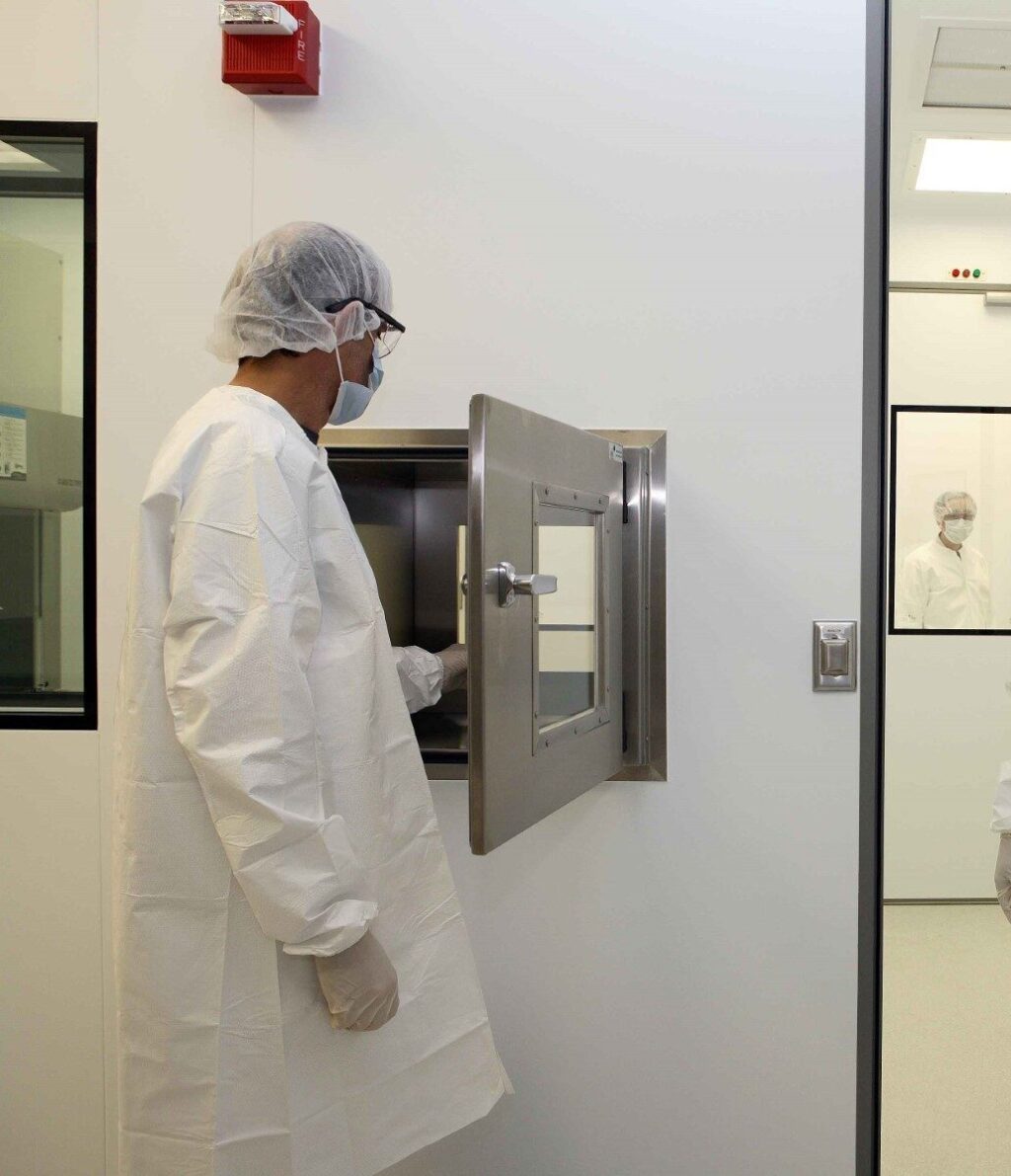

An ISO 8 cleanroom is a controlled environment designed to maintain defined airborne particle concentration limits under ISO 14644-1. Commonly used in medical device manufacturing, pharmaceutical support operations, diagnostics production, and other contamination-sensitive applications, ISO Class 8 provides controlled air cleanliness where more stringent classifications may not be necessary.
However, meeting ISO 8 requirements involves more than achieving an acceptable particle count. Effective cleanroom performance depends on coordinated HVAC design, filtration, personnel and material flow, gowning practices, environmental monitoring, cleaning, and ongoing maintenance.
Selecting the appropriate classification is an important early facility planning decision. Over-classifying a space can increase construction and operating costs, while under-classifying it can introduce unnecessary contamination risks.
For manufacturers evaluating controlled environments, AES Clean Technology provides modular cleanroom solutions designed around process requirements, contamination control, operational efficiency, and future scalability.
Key Takeaways
- ISO 8 cleanrooms must meet defined airborne particle concentration limits under ISO 14644-1.
- ISO Class 8 permits a maximum of 3,520,000 particles per cubic meter at sizes ≥0.5 µm.
- ISO 8 may be appropriate for certain medical device manufacturing, diagnostics, controlled assembly, and pharmaceutical support applications.
- ISO Class 8 permits ten times the airborne particle concentration of ISO 7 at corresponding particle sizes.
- HVAC, filtration, pressure control, gowning, cleaning, and environmental monitoring should reflect manufacturing risks.
- ISO 8 classification alone does not establish FDA, cGMP, or sterile manufacturing compliance.
On This Page
- What Is an ISO 8 Cleanroom?
- ISO 8 Cleanroom Particle Limits
- ISO 7 vs ISO 8: Understanding the Differences
- When Does an ISO 8 Cleanroom Make Sense?
- ISO 8 Cleanroom Design Requirements
- ISO 8 Gowning and Operational Standards
- ISO 8 Cleanroom Monitoring and Testing
- ISO 8 Cleanroom Requirements Checklist
- Download the ISO 8 Cleanroom Requirements Checklist
- Common ISO 8 Cleanroom Mistakes
- FAQ: ISO 8 Cleanroom Standards
- Sources
What Is an ISO 8 Cleanroom?
An ISO 8 cleanroom, also referred to as ISO Class 8, is a controlled environment classified according to the maximum allowable concentration of airborne particles under ISO 14644-1.
ISO 8 is commonly associated with the former U.S. Federal Standard 209E Class 100,000 cleanroom designation.
While ISO 8 is less stringent than ISO 7, it still provides a defined level of air cleanliness for manufacturing processes that require environmental control.
Common ISO 8 applications include:
- Medical device manufacturing and assembly
- Diagnostics production
- Certain non-sterile pharmaceutical operations
- Pharmaceutical preparation and support areas
- Controlled packaging
- Research and development
- Contamination-sensitive assembly operations
The appropriate cleanroom classification depends on product exposure, process risk, cleanliness specifications, and applicable regulatory requirements.
For pharmaceutical manufacturing, ISO classification should be evaluated alongside cGMP expectations. AES’s pharmaceutical cleanroom design guide explains how cleanroom classifications, HVAC, contamination control, and facility planning work together.
ISO 8 Cleanroom Particle Limits
Under ISO 14644-1:2015, ISO Class 8 establishes maximum allowable airborne particle concentrations at specified particle sizes.
ISO Class 8 Particle Concentration Limits
| Particle Size | Maximum Particles per m³ |
|---|---|
| ≥0.5 µm | 3,520,000 |
| ≥1.0 µm | 832,000 |
| ≥5.0 µm | 29,300 |
These values represent cumulative particle concentration limits for particles equal to or larger than each specified size.
ISO cleanroom classification also identifies the occupancy state being evaluated:
- As-built: The completed cleanroom without production equipment or personnel.
- At-rest: The cleanroom with equipment installed and operating as specified, but without personnel performing production activities.
- Operational: The cleanroom functioning under defined operating conditions with personnel present.
Important: ISO 14644-1 establishes airborne particle cleanliness classifications. It does not impose universal microbial limits, gowning requirements, air change rates, or room pressure differentials for every ISO 8 cleanroom.
For more detail on how classification affects facility planning, explore AES’s cleanroom ISO classification resource.
ISO 7 vs ISO 8: Understanding the Differences
One of the most important decisions in controlled environment planning is determining whether ISO 7 or ISO 8 provides the appropriate level of cleanliness.
Both classifications fall under ISO 14644-1, but ISO 7 establishes more stringent particle concentration limits.
ISO 7 vs ISO 8 Comparison
| Classification | ≥0.5 µm particles/m³ | ≥5.0 µm particles/m³ |
|---|---|---|
| ISO 7 | 352,000 | 2,930 |
| ISO 8 | 3,520,000 | 29,300 |
ISO 7 allows ten times fewer airborne particles than ISO 8 at these particle sizes.
However, a stricter classification is not automatically the best choice.
ISO 7 may be needed where manufacturing risks, product sensitivity, or regulatory expectations demand tighter control. ISO 8 may provide sufficient cleanliness for lower-risk processes and supporting spaces.
Higher cleanliness classifications can also require greater investment in HVAC, filtration, monitoring, qualification, and ongoing operations.
The objective is to select the classification appropriate for the process rather than automatically selecting the strictest environment.
For a deeper understanding of the higher-cleanliness classification, see AES’s ISO 7 cleanroom requirements guide, covering facility design, gowning, and operational standards.
When Does an ISO 8 Cleanroom Make Sense?
ISO 8 cleanrooms may be appropriate when manufacturing processes require controlled airborne particle levels but do not justify the more stringent limits of ISO 7 or ISO 5.
Medical Device Manufacturing
ISO Class 8 is frequently considered for medical device production where controlled cleanliness supports product quality.
Potential applications include:
- Device assembly
- Component preparation
- Controlled packaging
- Diagnostics manufacturing
- Selected device handling operations
Actual classification requirements depend on the product, manufacturing process, and quality system.
AES’s Life Science cleanroom solutions support medical device manufacturing, diagnostics, and other regulated production applications.
Pharmaceutical Support Areas
ISO 8 may also support certain pharmaceutical manufacturing activities where product and process risks allow a lower cleanliness classification.
FDA aseptic-processing guidance identifies ISO 8 as potentially appropriate for less-critical supporting activities, such as equipment cleaning.
However, ISO 8 should not be assumed suitable for exposed sterile products or critical aseptic operations, which generally require more stringent environmental controls.
Under EU GMP Annex 1, Grade D at-rest particle concentration limits are broadly aligned with ISO Class 8, but the two designations are not interchangeable. GMP grades introduce additional microbiological, monitoring, operating, and contamination-control expectations.
Controlled Assembly and Packaging
ISO 8 environments may also benefit manufacturing processes where airborne particles could affect product quality or consistency.
Appropriate controlled environments can help reduce particle exposure, establish repeatable material-handling procedures, and support consistent manufacturing conditions.
The classification should be selected according to the actual cleanliness needs of the product.
ISO 8 Cleanroom Design Requirements
Effective ISO 8 cleanroom design should coordinate HVAC, facility layout, construction materials, personnel practices, and process requirements.
1. HVAC, Filtration, and Airflow
HVAC systems help maintain the airborne particle concentration limits required for ISO Class 8.
Important design considerations include:
- Appropriate air filtration
- Supply and return airflow
- Air change rates
- Room recovery
- Temperature and humidity
- Pressure relationships
- Equipment heat loads
- Personnel occupancy
HEPA filtration is commonly used in ISO 8 cleanrooms, but ISO 14644-1 does not mandate one universal filtration configuration.
Similarly, ISO 14644-1 does not establish one mandatory air change rate for all ISO 8 cleanrooms.
As an application-specific reference, FDA’s aseptic-processing guidance indicates that at least 20 air changes per hour is typically acceptable for ISO 8 supporting rooms. This should not be interpreted as a universal ISO Class 8 requirement.
Airflow should instead be designed around the manufacturing process, room geometry, particle generation, equipment, occupancy, and recovery needs.
AES’s cleanroom engineering services integrate airflow, filtration, mechanical systems, and process requirements into coordinated facility designs.
2. Facility Layout and Pressure Control
A well-designed ISO 8 cleanroom should support efficient manufacturing while limiting unnecessary contamination risks.
Facility planning may include:
- Personnel gowning areas
- Controlled entry points
- Material transfer areas
- Equipment movement
- Waste removal routes
- Pressure relationships
- Maintenance access
Pressure control should align with product protection or containment requirements.
Positive pressure may be suitable for protecting the cleanroom from surrounding areas, while negative pressure may be needed for certain containment applications.
AES Compass™ conceptual facility planning helps manufacturers evaluate classification, zoning, process flows, HVAC, and equipment relationships before construction begins.
3. Cleanable Materials and Modular Construction
ISO 8 cleanroom construction should support consistent cleaning, durability, and ongoing contamination control.
Important considerations include:
- Smooth, cleanable walls and ceilings
- Sealed joints and penetrations
- Durable flooring
- Minimal particle-trapping surfaces
- Appropriate doors and windows
- Cleaning-agent compatibility
- Maintenance accessibility
Modular construction can also provide flexibility for manufacturers planning future expansion or facility reconfiguration.
AES’s modular cleanroom walls and ceilings offer integrated, cleanable systems for controlled manufacturing environments.
ISO 8 Gowning and Operational Standards
Personnel are a potential source of airborne particles and microorganisms, making gowning and behavior important components of cleanroom performance.
However, ISO 14644-1 does not prescribe one universal gowning ensemble for every ISO 8 cleanroom.
The appropriate gowning program should reflect product requirements, process risks, facility procedures, and applicable regulations.
Typical gowning considerations may include:
- Hair and beard covers
- Low-shedding cleanroom garments
- Dedicated cleanroom footwear or shoe covers
- Gloves, where appropriate
- Face coverings, where required
- Hand hygiene
- Documented gowning and degowning procedures
ISO 14644-5:2025 provides requirements for cleanroom operational control programs addressing personnel training, gowning, material transfers, cleaning, maintenance, and monitoring.
The objective is to minimize contamination introduced by personnel and maintain consistent operating practices throughout the controlled environment.
ISO 8 Cleanroom Monitoring and Testing
Achieving ISO 8 classification during initial testing is only one part of maintaining a controlled environment.
ISO 14644-2:2015 establishes requirements for monitoring plans that provide ongoing evidence of air cleanliness performance.
An ISO 8 monitoring program may include:
- Airborne particle monitoring
- Differential pressure monitoring
- Temperature and humidity
- Airflow verification
- Filter integrity testing
- Alarm conditions
- Data trending
- Microbiological monitoring, where required
Monitoring frequency, alert limits, and reassessment procedures should reflect process risks and applicable regulatory expectations.
Routine cleaning, personnel training, preventive maintenance, and change control should also support ongoing cleanroom performance.
AES’s cleanroom maintenance and service program provides ongoing support for controlled environment performance and lifecycle reliability.
ISO 8 Cleanroom Requirements Checklist
Before designing, qualifying, or operating an ISO Class 8 cleanroom, evaluate these 10 considerations:
- Classification Requirements: Define ISO Class 8 particle limits and the required occupancy state.
- Process and Contamination Risks: Identify the product, equipment, personnel, materials, and contamination hazards.
- HVAC and Filtration: Establish appropriate airflow, filtration, and environmental controls.
- Pressure Control: Define pressure relationships for product protection or containment.
- Facility Layout: Plan personnel entry, gowning, material transfers, equipment movement, and waste pathways.
- Cleanable Construction: Select durable, low-shedding materials with cleanable surfaces and sealed transitions.
- Personnel Gowning: Establish appropriate garments, gowning procedures, training, and personnel practices.
- Environmental Monitoring: Define particle monitoring, pressure verification, alarms, and process-specific controls.
- Cleaning and Maintenance: Implement documented cleaning, preventive maintenance, and contamination-control procedures.
- Testing and Documentation: Verify classification, maintain records, and establish periodic reassessment requirements.
Download the ISO 8 Cleanroom Requirements Checklist
Use this 10-point ISO 8 cleanroom checklist as a practical reference for evaluating cleanroom classification, HVAC and filtration, pressure control, facility layout, personnel gowning, environmental monitoring, cleaning, maintenance, and testing requirements.
Designed for facility planners, engineers, manufacturers, and quality teams, this downloadable resource highlights the considerations that help maintain ISO Class 8 cleanliness and support consistent cleanroom performance.

Common ISO 8 Cleanroom Mistakes
Common mistakes that can compromise ISO 8 cleanroom performance include:
- Selecting ISO 8 without evaluating product and process risks
- Assuming ISO classification automatically establishes GMP compliance
- Using arbitrary air change rates without assessing process needs
- Underestimating gowning and material transfer requirements
- Failing to coordinate HVAC with equipment placement
- Overlooking pressure control
- Selecting difficult-to-clean construction materials
- Neglecting personnel training
- Failing to establish appropriate environmental monitoring
- Treating certification as a one-time event
Avoiding these issues requires coordination between engineering, quality, operations, manufacturing, and cleanroom design teams.
The Bottom Line: Choose the Classification That Fits the Process
An ISO 8 cleanroom can provide an effective controlled environment where defined particle cleanliness is necessary but more stringent classifications are not justified.
Successful ISO Class 8 design requires coordination across:
- Process and contamination risks
- HVAC and filtration
- Facility layout
- Personnel and material flow
- Gowning
- Environmental monitoring
- Cleaning and maintenance
- Testing and documentation
- Future scalability
The strongest cleanroom strategy begins with understanding the manufacturing process and determining the appropriate level of environmental control.
For organizations evaluating new construction, expansion, or facility upgrades, AES Clean Technology’s turnkey modular cleanroom solutions integrate design, engineering, manufacturing, and construction to support high-performance controlled environments.
To discuss ISO 8 facility requirements, classification strategy, or modular cleanroom design, contact AES Clean Technology.
FAQ: ISO 8 Cleanroom Standards
What is an ISO 8 cleanroom?
An ISO 8 cleanroom is a controlled environment classified under ISO 14644-1 according to maximum allowable airborne particle concentrations. ISO Class 8 permits up to 3,520,000 particles per cubic meter at sizes ≥0.5 µm.
What are ISO 8 cleanroom requirements?
ISO 8 requirements establish airborne particle cleanliness limits. Maintaining those conditions also involves appropriate facility design, HVAC, filtration, monitoring, cleaning, personnel practices, and maintenance based on the process.
What is the difference between ISO 7 and ISO 8?
ISO 7 has more stringent particle limits than ISO 8. At ≥0.5 µm, ISO 7 permits 352,000 particles/m³, while ISO 8 permits 3,520,000 particles/m³.
Is ISO 8 the same as Class 100,000?
ISO Class 8 is commonly associated with the former U.S. Federal Standard 209E Class 100,000 designation. Modern cleanroom classification uses ISO 14644-1.
How many air changes per hour are required for ISO 8?
ISO 14644-1 does not prescribe one universal air change rate. FDA guidance identifies at least 20 air changes per hour as typically acceptable for ISO 8 aseptic-support rooms, but appropriate rates depend on process requirements and the facility design.
Does an ISO 8 cleanroom require HEPA filtration?
HEPA filtration is commonly used to achieve ISO 8 cleanliness. However, ISO 14644-1 specifies particle concentration limits rather than requiring one universal HVAC or filtration configuration.
What are ISO 8 gowning requirements?
ISO 8 gowning depends on manufacturing risks and facility procedures. Typical programs may include hair covers, low-shedding garments, dedicated footwear, gloves, and additional protective clothing where appropriate.
Is ISO 8 suitable for pharmaceutical manufacturing?
ISO 8 may be suitable for certain pharmaceutical preparation and support activities. However, critical aseptic processing zones where sterile product is exposed generally require more stringent environmental controls.
Is ISO Class 8 equivalent to GMP Grade D?
No. ISO 8 and EU GMP Grade D have broadly aligned at-rest particle limits, but Grade D includes additional contamination-control, microbiological, monitoring, and operational expectations.
How often should an ISO 8 cleanroom be tested?
Testing and reassessment should follow the applicable standards, monitoring plan, process risks, regulatory expectations, and facility quality system. ISO Class 8 alone does not establish one universal testing interval.
Sources
- ISO — ISO 14644-1:2015, Classification of Air Cleanliness by Particle Concentration
- ISO — ISO 14644-2:2015, Monitoring to Provide Evidence of Cleanroom Performance
- ISO — ISO 14644-4:2022, Design, Construction and Start-Up
- ISO — ISO 14644-5:2025, Cleanroom Operations
- FDA — Sterile Drug Products Produced by Aseptic Processing: Current Good Manufacturing Practice
- FDA — CGMP Regulations: Production and Process Controls Q&A
- European Commission — EU GMP Annex 1: Manufacture of Sterile Medicinal Products