

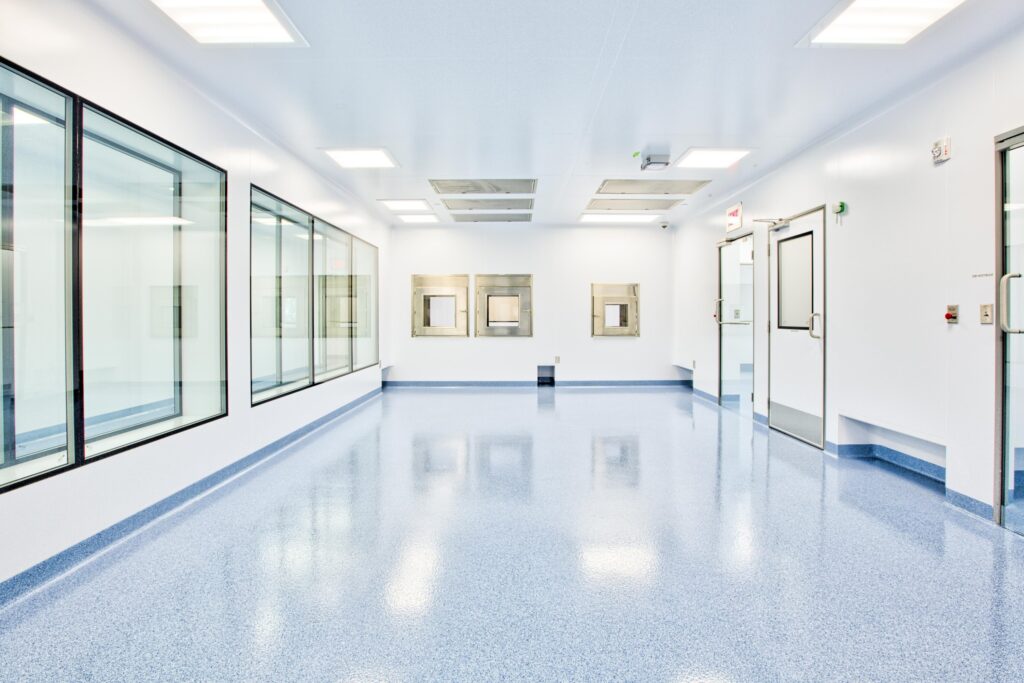


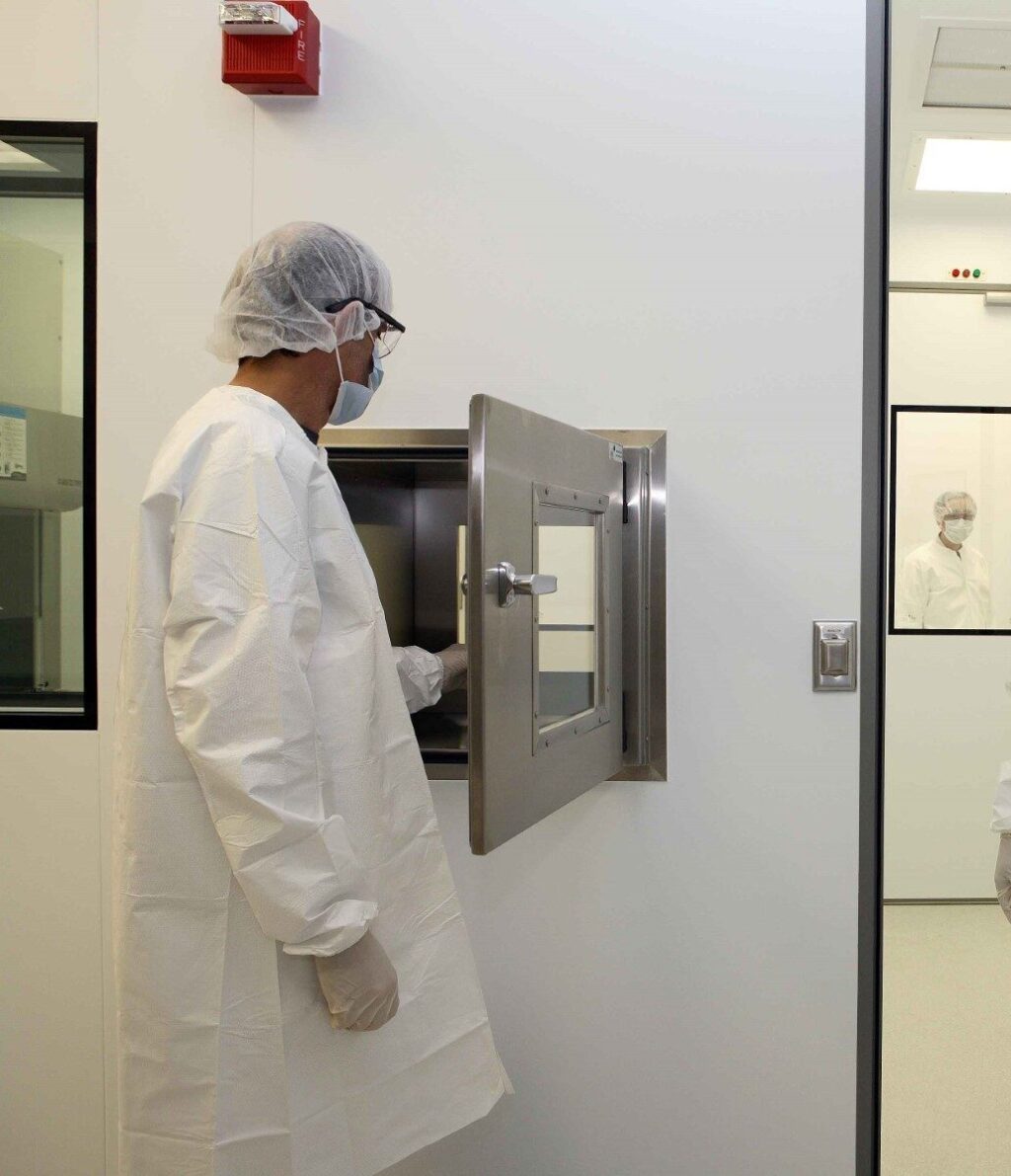

An ISO 7 cleanroom is a controlled environment designed to maintain defined airborne particle concentration limits under ISO 14644-1. Commonly used in pharmaceutical manufacturing, biotechnology, medical device production, and other contamination-sensitive applications, ISO Class 7 environments require coordinated facility design, airflow management, personnel practices, and ongoing operational control.
However, meeting ISO 7 requirements involves more than installing HEPA filters or achieving an acceptable particle count during certification. Cleanroom performance depends on the relationship between HVAC systems, pressure control, personnel movement, material transfers, cleaning procedures, environmental monitoring, and maintenance.
An appropriately designed ISO Class 7 cleanroom should support the intended manufacturing process while maintaining the specified air cleanliness level during the occupancy state defined for the facility.
For organizations planning a new cleanroom or expanding an existing manufacturing environment, AES Clean Technology provides modular cleanroom solutions designed to support regulated manufacturing requirements, operational efficiency, and future scalability.
Key Takeaways
- ISO 7 cleanrooms must meet defined airborne particle concentration limits under ISO 14644-1.
- ISO Class 7 permits no more than 352,000 particles per cubic meter at sizes ≥0.5 µm.
- ISO 7 gowning requirements should be established according to contamination risk, industry regulations, and documented operating procedures.
- HVAC, HEPA filtration, pressure relationships, cleanroom zoning, and material flow are critical design considerations.
- ISO 14644-5:2025 provides requirements for cleanroom operational control programs, including gowning, training, cleaning, maintenance, and monitoring.
- ISO 7 classification alone does not establish FDA or cGMP compliance for regulated pharmaceutical manufacturing.
On This Page
- What Is an ISO 7 Cleanroom?
- ISO 7 Cleanroom Particle Limits
- ISO 7 Cleanroom Design Requirements
- ISO 7 Gowning Requirements
- ISO 7 Operational Standards and Monitoring
- ISO 7 Cleanroom Requirements Checklist
- Download the ISO 7 Cleanroom Requirements Checklist
- Common ISO 7 Cleanroom Mistakes
- FAQ: ISO 7 Cleanroom Requirements
- Sources
What Is an ISO 7 Cleanroom?
An ISO 7 cleanroom, also referred to as ISO Class 7, is a cleanroom classified according to the allowable concentration of airborne particles under ISO 14644-1.
ISO 7 is commonly associated with the former U.S. Federal Standard 209E Class 10,000 designation.
ISO 7 cleanrooms can support applications such as:
- Pharmaceutical processing and manufacturing
- Biotechnology and biologics production
- Medical device manufacturing
- Compounding and controlled assembly
- Cleanroom support and preparation areas
- Certain sterile manufacturing support operations
The suitability of an ISO Class 7 environment depends on the process, product exposure, contamination risks, and applicable regulatory requirements.
For pharmaceutical applications, ISO classification should be considered alongside cGMP requirements. AES’s pharmaceutical cleanroom design guide explores how cleanroom classification, HVAC, contamination control, and facility planning work together in regulated manufacturing.
ISO 7 Cleanroom Particle Limits
Under ISO 14644-1:2015, ISO Class 7 establishes maximum permissible concentrations for airborne particles at specified particle sizes.
ISO Class 7 Particle Concentration Limits
| Particle Size | Maximum Particles per m³ |
|---|---|
| ≥0.5 µm | 352,000 |
| ≥1.0 µm | 83,200 |
| ≥5.0 µm | 2,930 |
These are cumulative particle concentration limits at the specified sizes, not independent limits for separate particle-size bands.
Important: ISO 14644-1 establishes airborne particle cleanliness classifications. It does not establish universal microbial contamination limits, gowning ensembles, room pressure differentials, or air change rates for every ISO 7 cleanroom.
Classification must also identify the applicable occupancy state, such as as-built, at-rest, or operational. The cleanroom should be evaluated against the state specified in its requirements.
For additional guidance on classification strategy and contamination control, explore AES’s cleanroom ISO classification resource.
ISO 7 Cleanroom Design Requirements
Effective ISO 7 cleanroom design begins with the intended manufacturing process and the contamination risks that must be controlled.
1. HVAC, HEPA Filtration, and Airflow
HVAC plays a central role in maintaining ISO Class 7 cleanliness.
An ISO 7 HVAC strategy should address:
- High-efficiency air filtration
- Appropriate supply and return airflow
- Air change rates based on process requirements
- Temperature and humidity control
- Room recovery
- Pressure relationships
- Equipment and personnel heat loads
- Airflow disruptions and obstructions
HEPA filtration is commonly used to help achieve ISO 7 particle cleanliness, but the complete HVAC strategy must be designed around the facility’s operations.
ISO 14644-1 does not prescribe one universal air change rate for every ISO 7 cleanroom. Appropriate airflow quantities depend on room geometry, equipment, personnel, contamination generation, recovery requirements, and operating conditions.
AES’s cleanroom engineering services integrate HVAC, airflow, pressure control, mechanical systems, and process requirements into coordinated cleanroom designs.
2. Facility Layout and Pressure Control
Cleanroom layout should support controlled movement of personnel, materials, equipment, products, and waste.
Important design considerations include:
- Personnel airlocks
- Material transfer areas
- Gowning rooms
- Appropriate pressure cascades
- Controlled access points
- Equipment clearances
- Maintenance access
- Cleaning and disinfection
Positive pressure may be appropriate when protecting the cleanroom from surrounding environments. Negative pressure may be required when hazardous material containment takes priority.
Pressure relationships must be established according to process risk rather than ISO classification alone.
For early-stage planning, AES Compass™ conceptual facility planning helps teams evaluate cleanroom zoning, classification, personnel flow, material flow, and HVAC requirements.
3. Cleanroom Materials and Construction
ISO 7 cleanroom construction should minimize particle generation and support routine cleaning.
Recommended design considerations include:
- Smooth, durable wall and ceiling finishes
- Cleanable floors and transitions
- Sealed joints and penetrations
- Minimal horizontal ledges
- Appropriate doors and windows
- Durable surfaces compatible with cleaning agents
- Access for maintenance and equipment replacement
AES’s modular cleanroom walls and ceilings support cleanable, durable controlled environments with modular construction that can accommodate future modifications and expansions.
ISO 7 Gowning Requirements
ISO 7 gowning is an important part of contamination control because personnel can introduce particles and microorganisms into the cleanroom through clothing, skin, hair, and movement.
However, ISO 14644-1 does not mandate one universal gowning ensemble for all ISO Class 7 cleanrooms.
The appropriate gowning program should reflect process risk, product requirements, applicable GMP expectations, and the facility’s documented procedures.
ISO 14644-5:2025 establishes requirements for cleanroom operational control programs, including personnel management and gowning.
Typical ISO 7 Gowning Considerations
Depending on the application, an ISO 7 gowning program may include:
- Hair covers
- Beard covers, where applicable
- Low-shedding cleanroom garments or coveralls
- Dedicated cleanroom footwear or shoe covers
- Gloves
- Face masks, where required
- Appropriate hand hygiene
- Defined garment replacement and handling procedures
Garment requirements may be more stringent in pharmaceutical or microbiologically sensitive environments.
For example, EU GMP Annex 1 identifies specific gowning expectations for Grade C areas, including covered hair and facial hair, suitable low-shedding garments, and disinfected footwear. These requirements should not automatically be applied to every ISO 7 cleanroom, because ISO classes and EU GMP grades are not interchangeable regulatory designations.
Recommended ISO 7 Gowning Sequence
A documented gowning procedure may follow this general sequence:
- Remove prohibited personal items and inspect gowning supplies.
- Perform hand hygiene according to facility procedures.
- Apply appropriate hair and beard coverings.
- Don cleanroom garments without contaminating their outer surfaces.
- Apply dedicated cleanroom footwear or shoe covers.
- Don masks and gloves where specified.
- Inspect gowning integrity before entering the controlled area.
The exact sequence should be established and validated as appropriate to the facility’s contamination control procedures.
The objective is not simply to wear cleanroom clothing, but to prevent contamination from entering or spreading throughout the controlled environment.
ISO 7 Operational Standards and Monitoring
Maintaining ISO Class 7 conditions requires more than initial certification.
ISO 14644-5:2025 establishes requirements for an operational control program addressing personnel, material movement, gowning, cleaning, maintenance, training, and monitoring.
ISO 14644-2:2015 establishes requirements for monitoring plans that provide evidence of continued air cleanliness performance.
Environmental Monitoring
An ISO 7 cleanroom monitoring program may address:
- Airborne particle concentrations
- Room differential pressure
- Temperature and humidity
- Airflow and recovery performance
- HEPA filter integrity
- Viable environmental monitoring, where applicable
- Operational alarms and trends
Monitoring plans should be based on contamination risk, applicable regulations, and the conditions necessary to maintain control.
Cleaning and Maintenance
Routine operational controls should include:
- Documented cleaning procedures
- Cleaning and disinfectant compatibility
- Appropriate cleaning frequencies
- Controlled material transfer
- Equipment cleaning
- Personnel training
- Preventive maintenance
- Filter inspections and replacement
- Investigation of deviations
- Change control
Cleanroom performance should be supported by ongoing monitoring, periodic verification, and documented corrective actions where necessary.
AES’s cleanroom maintenance and service program helps facilities maintain performance, address equipment and envelope issues, and support long-term operational reliability.
ISO 7 Cleanroom Requirements Checklist
Before designing, qualifying, or operating an ISO Class 7 cleanroom, confirm that the facility addresses these 10 considerations:
- Classification Requirements — Define ISO Class 7 particle limits and the applicable occupancy state.
- Process and Contamination Risks — Identify the product, equipment, personnel, materials, and contamination hazards.
- HVAC and HEPA Filtration — Design filtration and airflow appropriate to the intended cleanliness level and process.
- Pressure Control — Establish pressure relationships appropriate to product protection or containment.
- Cleanroom Layout — Provide suitable gowning areas, airlocks, access points, and controlled personnel and material flows.
- Cleanable Construction — Select durable, low-shedding materials and properly sealed cleanroom finishes.
- ISO 7 Gowning — Establish appropriate garments, gowning procedures, training, and personnel practices.
- Environmental Monitoring — Define particle monitoring, pressure verification, alarms, and other process-specific controls.
- Cleaning and Maintenance — Implement documented cleaning, equipment maintenance, and contamination-control procedures.
- Testing and Documentation — Verify cleanroom performance through appropriate testing, classification, records, and periodic reassessment.
Download the ISO 7 Cleanroom Requirements Checklist
Use this 10-point ISO 7 cleanroom checklist as a practical reference for evaluating cleanroom classification, HVAC and HEPA filtration, pressure control, facility layout, ISO 7 gowning, environmental monitoring, cleaning, maintenance, and testing requirements.
Designed for facility planners, engineers, and quality teams, this resource helps identify critical considerations for maintaining ISO Class 7 cleanliness and supporting consistent cleanroom performance.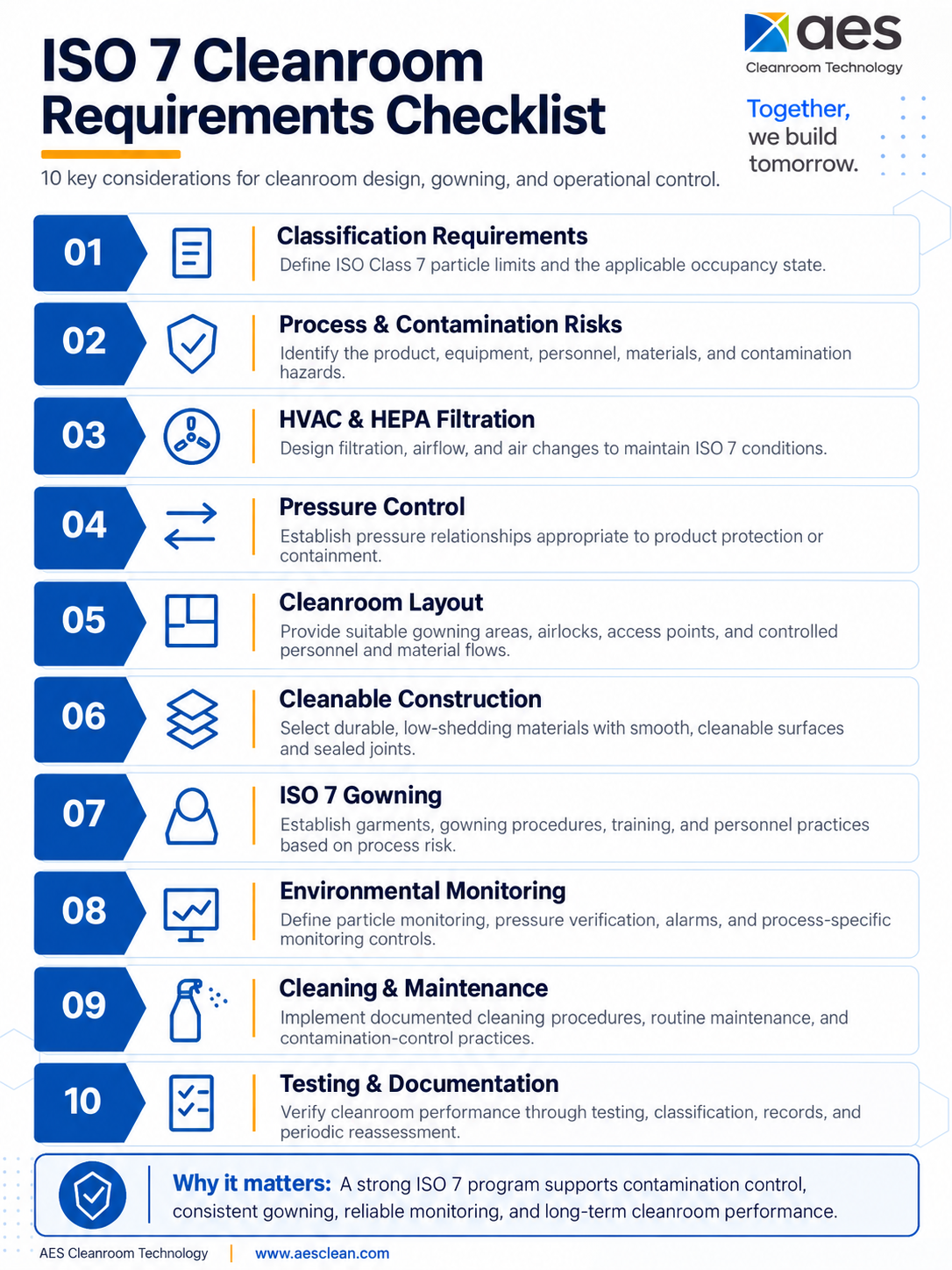
Common ISO 7 Cleanroom Mistakes
Common mistakes that can undermine ISO 7 cleanroom performance include:
- Assuming ISO 7 classification automatically establishes GMP compliance
- Applying arbitrary air change rates without evaluating process requirements
- Designing inadequate gowning or material transfer areas
- Failing to account for equipment-related airflow disruption
- Using materials that are difficult to clean or maintain
- Overlooking pressure control
- Allowing inconsistent gowning practices
- Failing to define the required classification occupancy state
- Treating certification as a one-time event
- Neglecting ongoing environmental monitoring and maintenance
Avoiding these issues requires early coordination between process, quality, engineering, operations, and cleanroom design teams.
The Bottom Line: ISO 7 Compliance Requires Integrated Design and Operational Control
Meeting ISO 7 cleanroom requirements is not simply a matter of achieving acceptable particle counts during a classification test.
Long-term cleanroom performance depends on coordinated facility design, HVAC, filtration, personnel gowning, contamination prevention, cleaning, environmental monitoring, and maintenance.
The strongest ISO Class 7 cleanrooms are designed around both the required cleanliness level and the operational demands of the manufacturing process.
For organizations planning a new ISO 7 cleanroom, expanding existing capacity, or upgrading a controlled environment, AES Clean Technology’s turnkey modular cleanroom solutions integrate design, engineering, manufacturing, and construction.
To discuss cleanroom classifications, layout, airflow, modular construction, or facility upgrades, contact AES Clean Technology.
FAQ: ISO 7 Cleanroom Requirements
What is an ISO 7 cleanroom?
An ISO 7 cleanroom is a controlled environment classified under ISO 14644-1 according to defined airborne particle concentration limits. ISO Class 7 permits up to 352,000 particles per cubic meter at sizes ≥0.5 µm.
What are ISO 7 cleanroom requirements?
ISO 7 requirements primarily establish airborne particle cleanliness limits. Maintaining the classification also involves suitable facility design, HVAC, filtration, monitoring, cleaning, personnel practices, and maintenance. Additional requirements depend on the manufacturing process and applicable regulations.
What are the ISO 7 gowning requirements?
ISO 7 gowning requirements depend on the process and contamination risks. Typical gowning programs may include hair covers, low-shedding garments, cleanroom footwear, gloves, and masks where needed. ISO 14644-5:2025 addresses the establishment of an operational gowning program.
How many particles are allowed in an ISO Class 7 cleanroom?
ISO Class 7 allows a maximum of 352,000 particles/m³ at ≥0.5 µm, 83,200 particles/m³ at ≥1.0 µm, and 2,930 particles/m³ at ≥5.0 µm under ISO 14644-1:2015.
How many air changes per hour are required for ISO 7?
ISO 14644-1 does not establish one mandatory air change rate for all ISO 7 cleanrooms. Airflow requirements should be determined by room size, process contamination risks, occupancy, equipment, recovery expectations, and the overall HVAC design.
What is the difference between ISO 7 and ISO 8?
ISO 7 permits fewer airborne particles than ISO 8. At ≥0.5 µm, ISO 7 permits 352,000 particles/m³, while ISO 8 permits 3,520,000 particles/m³. ISO 7 therefore has a tenfold lower particle concentration limit at this size.
Is ISO Class 7 the same as GMP Grade C?
Not exactly. ISO Class 7 is an airborne particle classification. EU GMP Grade C has additional regulatory expectations and different particle limits for at-rest and operational states. An ISO 7 cleanroom should not automatically be considered Grade C compliant.
Does an ISO 7 cleanroom require HEPA filtration?
HEPA filtration is commonly used in ISO 7 cleanrooms to achieve the required particle cleanliness. However, ISO 14644-1 defines cleanliness performance rather than mandating one universal HVAC or filtration configuration.
How often should an ISO 7 cleanroom be tested?
Testing and reassessment should follow the applicable standard, monitoring plan, process risks, quality system, and regulatory requirements. There is no universal requalification interval imposed by ISO Class 7 alone.
Sources
- ISO — ISO 14644-1:2015, Classification of Air Cleanliness by Particle Concentration
- ISO — ISO 14644-2:2015, Monitoring to Provide Evidence of Cleanroom Performance
- ISO — ISO 14644-4:2022, Design, Construction and Start-Up
- ISO — ISO 14644-5:2025, Cleanroom Operations
- FDA — Sterile Drug Products Produced by Aseptic Processing: Current Good Manufacturing Practice
- European Commission — EU GMP Annex 1: Manufacture of Sterile Medicinal Products